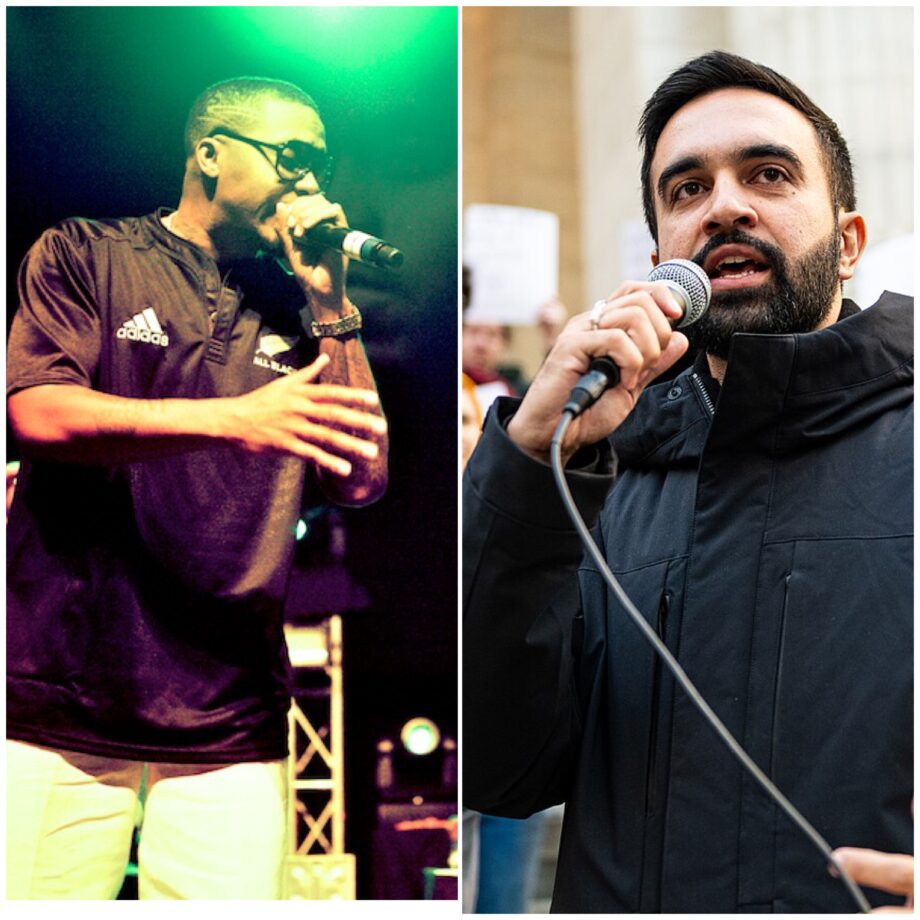
Nas and Zohran Mamdani reconnect with hip-hop’s roots, raising a bigger question: can New York remain the culture’s spiritual home when the world has made it its own?
There’s something poetic about Nas sitting down with New York City Mayor Zohran Mamdani in Queensbridge earlier this month. This was more than a meeting between a rap legend and a politician and former rapper. It’s a conversation about the soul of hip-hop, its origins and what it means to belong to a culture that has travelled far beyond the five boroughs.
New York gave the world hip-hop. The Bronx gave it the block parties, the breakbeats and the blueprint. Queensbridge, Brooklyn and Harlem gave it stories, characters and voices that would shape generations. From graffiti-covered walls to park jams, from boom bap to street poetry, the culture grew out of communities that turned everyday life into art.
Nas became one of its greatest storytellers, documenting the beauty and brutality of his surroundings with a clarity that made Queensbridge resonate worldwide. But hip-hop was never going to stay in New York. It was always too restless, too rebellious and too universal for that.
Today, the culture speaks in a thousand different accents. UK gave us grime and drill. France, Germany, Netherlands and many other European countries developed its own hip-hop identity. Ghana, Nigeria, South Africa are pushing African hip-hop into new territory, while South Korea, Japan, China, Brazil, Mexico and many other countries across the globe continue to remix the formula.
Atlanta has transformed the sound of American Hip-hop over the past 2 decades, before this you had the West Coast sound and other parts of the South including Houston, Miami and New Orleans that equally had their own contribution and dominating hip-hop at the time.
Nobody is waiting for New York’s permission anymore. And why should they? The greatest thing New York ever did was create a culture powerful enough to outgrow its birthplace.
But that leaves an interesting question hanging over Nas and Mamdani’s conversation: can New York still call itself hip-hop’s home, or has it become a place the culture looks back to rather than looks towards?
Being the birthplace and being the centre of the conversation are two different things. Hip-hop has always been about what happens next. New sounds, new slang, new dances, new fashion, new ways of telling stories. It thrives on the next kid with a microphone, the next DJ flipping a record, the next crew creating a movement nobody saw coming.
And that is where New York’s challenge lies. A culture cannot live on its greatest moments forever. Nas, Biggie, Jay-Z, Wu-Tang Clan, Run-DMC and the pioneers who came before them built an extraordinary legacy. But legacy alone doesn’t make a scene. The culture needs new voices, new energy and spaces where creativity can happen organically.
New York must remain more than a backdrop for hip-hop documentaries, anniversary concerts and nostalgic playlists. It needs to keep producing the sounds, styles and personalities that move the culture forward. Perhaps Mamdani and Nas are really asking whether the city can preserve the spirit that made hip-hop so special in the first place — the hunger, the experimentation, the community and the refusal to be boxed in.
Because hip-hop was never just about where you came from. It was about what you did with it. The global explosion of the culture should be celebrated, not feared. A rapper in in Europe or Asia doesn’t diminish Nas. An artist in Lagos or Senegal doesn’t erase the Bronx. They extend the story, proving that a movement born in New York can speak to lives and experiences everywhere.
Hip-hop belongs to the world now. But New York will always be where the story began. The real question is whether it can remain a place where the next chapter is written. New York doesn’t need to reclaim the crown from other parts of the world. It needs to keep creating, keep inspiring and keep giving young people a reason to pick up a mic, step behind the decks.
Nas represents the legacy. Mamdani represents the possibility of what comes next. Their conversation is a reminder that hip-hop’s future is not guaranteed by its history .New York gave the world the blueprint. The world took it and built something extraordinary. However, Hip-hops expansion has transcended into global markets, and those global markets have been smart in embedding and infusing their own cultures and sounds.
Now New York has to prove it can still surprise us. You can never take hip-hop’s birthplace away from New York like Sedgewick Park, Kool Herc and all the forefathers who created it and those legends from New York who came after, but keeping its New Yorks spirit alive? That is a different kind of legacy.


